


With The Rain Comes the Odors
Reading Time: Approximately 7 Minutes
You hear the rain against the windows, walk into the house, and suddenly notice it—that unmistakable damp, earthy, musty smell.
Yesterday the house smelled perfectly normal. Today, after several hours of rain, something seems different.
If your house smells musty when it rains, the rain may not actually be creating the odor. Instead, wet weather can change moisture and humidity conditions around your home, making an existing moisture or odor problem easier to notice.
For Maryland homeowners, that makes a recurring rainy-day odor worth investigating. The real question isn't simply, “How do I get rid of the smell?”
It's “Where is the smell coming from?”
Quick Answer: Why Does a House Smell Musty When It Rains?
A house may smell musty during or after rain because increased moisture, water intrusion, elevated indoor humidity, damp porous materials, crawl-space or basement conditions, condensation, or inadequate ventilation can create or intensify odor problems.
The U.S. Environmental Protection Agency identifies musty odors, rainwater intrusion, damp areas, foundation leaks, condensation, and excessive humidity among the signs that should prompt an investigation for moisture problems.
That doesn't mean every musty odor is mold.
It means a recurring odor associated with wet weather is a clue that moisture may be interacting with something in or around the building.
Key Takeaways
- A musty smell that appears during rainy weather often points toward a moisture-related condition somewhere in the home.
- Basements and crawl spaces are common sources, but they aren't the only possibilities.
- Roof leaks, window penetrations, foundation seepage, HVAC systems, carpeting, insulation, stored materials, and poor drainage can also contribute.
- A musty smell does not automatically prove that mold is present.
- Indoor relative humidity should generally remain below 60%; the EPA identifies roughly 30–50% as an ideal range for many homes.
- Air fresheners may change what you smell without correcting the condition producing the odor.
- When the smell repeatedly returns with rain, identifying the source of moisture and the source of odor is more important than masking it.
Why Rain Can Change the Way Your House Smells
Rain changes the moisture environment surrounding a building.
The soil around the foundation becomes wetter. Outdoor relative humidity may rise. Building materials can absorb additional moisture. Small leaks or drainage deficiencies may become active. Crawl spaces can become damper, and moisture can enter through cracks, joints, windows, roofs, utility penetrations, or other vulnerable areas.
Water doesn't have to be pouring through a ceiling for moisture to become a problem.
The EPA's moisture-control guidance identifies numerous pathways for water movement through buildings, including site drainage, foundations, walls, roofs, plumbing systems, and HVAC systems.
That's why the timing of an odor can be useful information.
If the house consistently smells normal during dry weather but becomes musty during or shortly after rain, the weather is giving you a clue.
Also Read 📖OdorPro Tips: Keep Your Maryland Home Smell-Free Year Round
A Musty Smell Does Not Automatically Mean Mold
This distinction is important.
People frequently use the words musty, moldy, mildew, damp, earthy, and stale interchangeably. A homeowner may therefore assume that any musty odor proves there is mold somewhere in the house.
Odor alone cannot make that diagnosis.
The EPA specifically notes that odor is not a reliable test of overall indoor air quality, and people's perception of odors varies.
However, the EPA also recognizes musty odors as one of the signs that can justify investigating a building for moisture problems.
In other words:
Don't panic over the smell—but don't ignore a recurring pattern either.
The goal is to determine what environmental condition changes when it rains and whether that change is revealing an underlying odor source.
Also Read 📖Why Your New Home Still Smells After Cleaning (And What It Means)
7 Places to Investigate When Your House Smells Musty After Rain
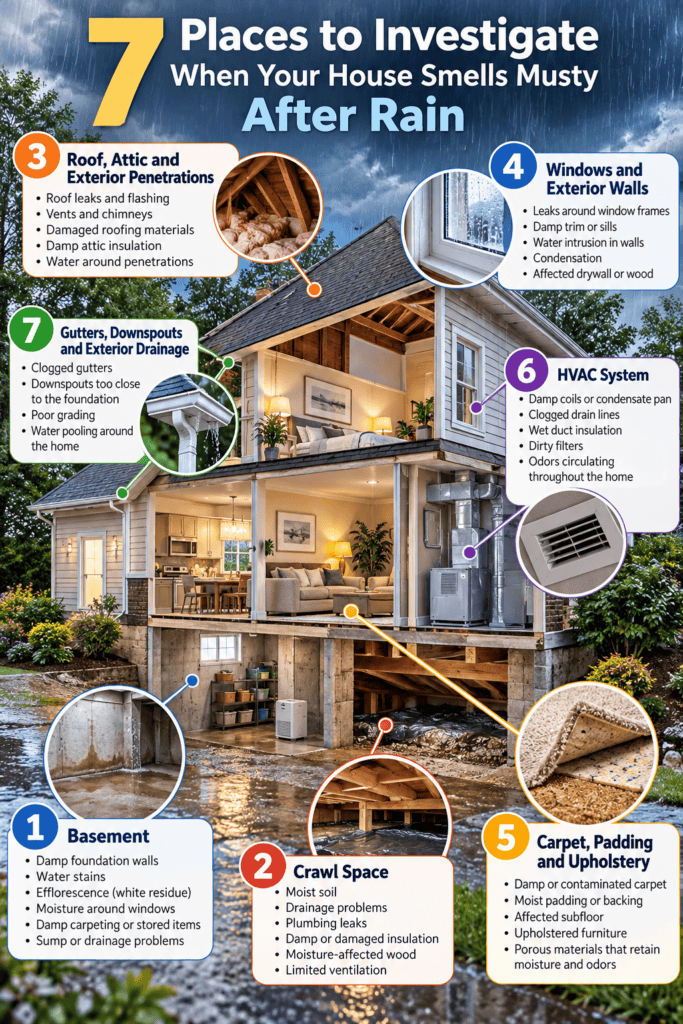
The room where you notice the odor isn't necessarily where the problem begins.
Air moves through a home. HVAC systems circulate it. Pressure differences move air between floors. Odors can migrate from concealed or lower areas into living spaces.
Start with the places most likely to be affected by moisture.
1. Basement
Basements naturally deserve attention because they're below or partially below grade and surrounded by soil.
After prolonged rainfall, look for:
- Damp foundation walls
- Water stains
- Efflorescence or mineral deposits
- Wet basement corners
- Damp carpeting
- Moisture around windows
- Sump or drainage problems
- Stored cardboard or fabrics that feel damp
A basement doesn't need standing water to develop a moisture problem.
If your odor is concentrated downstairs, read Basement Smells Like a Swamp? Mold, Musty & Sewage Odors Explained for a deeper look at basement-specific odor sources.
2. Crawl Space
The crawl space may be out of sight, but it shouldn't be out of mind.
Moist soil, drainage problems, plumbing leaks, wet insulation, damp wood, inadequate moisture control, or water intrusion can all change conditions beneath a home.
An odor originating below the living area can also migrate upward.
If your house develops a stronger odor after several rainy days rather than immediately after the first raindrops fall, the crawl space is one area worth investigating.
3. Roof, Attic and Exterior Penetrations
Not every roof leak announces itself with water dripping from the ceiling.
Rain can enter around flashing, vents, chimneys, roof penetrations, damaged roofing materials, or exterior joints and wet materials concealed from view.
Look for:
- Ceiling discoloration
- Peeling paint
- Damp attic insulation
- Water staining around penetrations
- Changes in odor near exterior walls
- Staining around chimneys or vents
A smell that consistently follows heavy or wind-driven rain can provide an important clue about where to look.
4. Windows and Exterior Walls
Windows are another common location for moisture intrusion and condensation.
Check around frames, trim, sills, and the wall below the window.
Repeated wetting can affect drywall, wood, insulation, carpeting, and other porous materials—sometimes in areas that aren't immediately visible.
5. Carpet, Padding and Upholstery
Porous materials can absorb moisture and retain existing contamination and odors.
Carpet is especially important because what you see on the surface is only one layer. Moisture or contamination may also involve the backing, padding, underlayment, or subfloor.
The EPA specifically identifies carpets among the areas or materials that can be associated with musty odors and moisture problems.
6. HVAC System
Your HVAC system can complicate odor investigations because it moves air throughout the building.
Moisture around coils, condensate pans or drains, damp duct insulation, dirty filters, or an odor entering the return-air system from another part of the house can make a localized problem seem like a whole-house odor.
If the musty smell becomes noticeably stronger when your HVAC system starts running, that's useful diagnostic information.
Learn more in How HVAC Systems Affect Household Odors.
7. Gutters, Downspouts and Exterior Drainage
Sometimes the odor problem begins outside the house.
If gutters overflow, downspouts discharge too close to the foundation, grading directs water toward the building, or drainage cannot keep up with rainfall, more water can accumulate around the foundation.
The EPA recommends maintaining roof gutters and ensuring the ground slopes away from the foundation to reduce water intrusion.
This is an important reminder:
An indoor odor problem can sometimes begin with an outdoor water-management problem.
Also Read 📖What Role Does Our HVAC Play in Our Household Odors?
What Happens to a Home When It Rains?

Think of the process as a chain rather than a single event:
Rainfall
↓
More moisture around the building
↓
Higher humidity and/or water intrusion
↓
Porous materials become damp or existing moisture problems worsen
↓
Odor-producing conditions become more noticeable
↓
Air movement carries the odor into occupied areas
This is why a rainy-day smell can seem to appear almost magically.
The odor may not be new.
The environmental conditions that make it noticeable are what changed.
Also Read 📖Maryland’s 10 Worst Smells (And How Pros Remove Them)
Humidity Is One of the Best Clues Homeowners Can Measure
One of the simplest tools for investigating a rainy-day odor problem is a hygrometer, which measures relative humidity.
The EPA recommends keeping indoor humidity below 60% when possible and generally identifies 30–50% relative humidity as an ideal range.
Take measurements in several locations rather than relying on a single reading:
- Basement
- First floor
- Bedrooms
- Near the suspected odor
- Near HVAC returns
- Near crawl-space access
Then compare those readings during dry weather and rainy weather.
You're looking for a pattern.
If one area repeatedly becomes substantially more humid when it rains—and that's also where the odor becomes strongest—you've gained useful information for identifying the source.
Also Read 📖Hidden Science of Odor Removal in Maryland | Maryland OdorPros
What Homeowners Can Check After the Next Rainstorm
Instead of immediately reaching for an air freshener, use the next rainy day as an opportunity to investigate.
Walk through the home and pay attention to:
Where is the smell strongest?
Does it become stronger near the basement stairs, an exterior wall, a particular room, a closet, HVAC vent, crawl-space entrance, or window?
When does it begin?
During the rain? Several hours later? The next morning?
Does the HVAC affect it?
Does the smell intensify when the air conditioning or heating system begins circulating air?
Can you see moisture?
Look for condensation, staining, peeling paint, damp flooring, wet insulation, foundation seepage, or other visible changes.
What is the relative humidity?
Record it.
Those observations can be far more useful than simply describing the odor as “musty.”
Why Air Fresheners Don't Solve a Recurring Rainy-Day Odor

A fragrance can change what your nose perceives.
It cannot repair a leaking window, improve exterior drainage, dry wet insulation, correct a condensate problem, or remove contamination from a porous material.
This is the difference between odor masking and source correction.
If an odor returns whenever the weather changes, repeatedly adding fragrance can actually make the situation more confusing because now you're smelling the original odor mixed with another scent.
A better approach is:
Find the moisture. Find the odor source. Correct the underlying problem. Then address any remaining odor contamination.
Also Read 📖The Psychology of Smell: How Home Odors Affect Mood & Behavior
When Should You Call a Professional?
A one-time damp smell after leaving a window open during a storm is very different from a house that becomes musty every time it rains.
Professional investigation becomes increasingly reasonable when:
- The odor repeatedly returns after rainfall
- You cannot locate the source
- The smell is becoming stronger
- Multiple rooms are affected
- There is evidence of previous water damage
- Carpeting, drywall, insulation or other porous materials have been wet
- The smell continues even after humidity has returned to normal
- You suspect the odor is moving through the HVAC system
- Cleaning changes the smell temporarily, but it keeps coming back
Different problems may also require different professionals. Active plumbing leaks, roofing failures, foundation water intrusion, HVAC problems, or significant mold contamination may require specialists in those fields before odor remediation can be completed successfully.
Maryland Odor Pros: Find the Source Before You Fight the Smell
A persistent odor is frustrating because your nose tells you something is wrong without telling you exactly where it's wrong.
That's where source identification becomes important.
Maryland Odor Pros approaches persistent odors by looking beyond the room where the smell happens to be noticeable. The objective is to determine where the odor originates, what materials or spaces are involved, and whether another underlying problem must be corrected before odor treatment can succeed.
Because if moisture keeps returning, treating only the smell is unlikely to provide a lasting solution.
The Bottom Line
If your house smells musty when it rains, don't assume that rainy weather simply makes houses smell that way.
Look for the pattern.
Rain may be revealing a moisture pathway, damp material, ventilation issue, hidden contamination, basement or crawl-space condition, HVAC issue, or another odor source that becomes more noticeable when moisture levels change.
Your nose noticed the symptom.
Now it's time to find the source.
If a musty odor keeps returning every time Maryland weather turns wet, contact Maryland Odor Pros for professional odor-source identification and remediation.
Call Maryland Odor Pros: 410-508-4109
Serving homeowners and property managers throughout Maryland.
Contact Us For an Appointment Today!

Frequently Asked Questions
1. Why does my house smell musty when it rains?
Rain can increase moisture around and sometimes inside a home. Higher humidity, water intrusion, damp porous materials, basement or crawl-space moisture, condensation, and ventilation conditions can make existing odor sources more noticeable. A recurring rainy-day odor is therefore worth investigating for an underlying moisture source.
2. Does a musty smell mean I have mold?
Not necessarily. A musty odor can be associated with moisture and microbial growth, but odor alone cannot confirm the presence of mold. Visible growth, water damage, persistent dampness, and other evidence should also be considered when investigating the source.
3. What indoor humidity level should I maintain?
The EPA recommends keeping indoor relative humidity below 60% when possible and generally identifies approximately 30–50% as an ideal range. A simple digital hygrometer can help homeowners monitor humidity changes between dry and rainy weather.
4. Why does my basement smell worse after heavy rain?
Rain can increase soil moisture around a foundation and may reveal drainage, seepage, humidity, or water-intrusion problems. Basements also contain porous materials capable of absorbing moisture and retaining odors, making them common locations for rainy-weather odor problems.
5. Can a crawl space make the entire house smell musty?
Yes. Air and odors can move from crawl spaces into occupied areas of a home. Damp soil, wet insulation, moisture-affected wood, plumbing leaks, drainage problems, or other crawl-space conditions may contribute to odors that become noticeable upstairs.
6. Can my HVAC system spread a musty smell?
Yes. HVAC systems move large volumes of air throughout a home. An odor originating in one area may enter the return-air system and become noticeable in other rooms. Moisture or contamination within HVAC components can also contribute to persistent odors.
7. Will a dehumidifier eliminate a musty smell?
A dehumidifier can help when excessive humidity contributes to the problem, but it will not repair water intrusion or remove an established odor source by itself. Humidity control should be considered one part of a larger source-identification and correction process.
8. Why can I smell a musty odor even when I can't find anything wet?
Moisture can exist in concealed locations such as behind walls, beneath flooring, inside insulation, around foundations, in crawl spaces, or within HVAC components. Some materials may also remain damp or retain odors even after their visible surfaces appear dry.
9. Should I use an air freshener for a musty smell?
An air freshener may temporarily change what you smell, but it does not correct moisture intrusion or remove the underlying odor source. Recurring odors are better addressed by identifying and correcting their source rather than continually masking them with fragrance.
10. When should I contact an odor-removal professional?
Consider professional assistance when an odor repeatedly returns, spreads through several rooms, persists after cleaning and humidity control, follows water damage, or cannot be traced to an obvious source. The appropriate solution begins with determining what is producing the odor and whether a moisture, building, plumbing, HVAC, or other underlying issue also needs correction.
Previous Article: How to Remove Moldy Smells From Boat Cabins: A Maryland Boater’s Complete Guide
Next Article: Why Does My House Smell After Vacation? | Maryland Odor Pros