

Why Does My House Smell Different After I’ve Been Away?
⏱️Estimated Read Time 8–9 minutes
Executive Summary
Have you ever returned from vacation, opened the front door, and immediately thought, “Did my house always smell like this?” There is a scientific reason that familiar household odors can suddenly seem stronger after you've been away. Olfactory adaptation—often called nose blindness—can make us less aware of odors we're exposed to every day.
But a freshly noticeable odor shouldn't automatically be dismissed as nose blindness. While a home is unoccupied, changes in humidity, ventilation, HVAC operation, drains, pet areas, food waste, and moisture conditions can also alter the indoor environment. This article explains why homes sometimes smell different after vacation, how homeowners can use their temporarily “fresh nose” to investigate the source, and when a persistent or unexplained odor deserves professional attention.
Key Takeaways
- 👃 Your nose adapts to familiar odors. Olfactory adaptation can make everyday household smells much less noticeable until you've spent time away from them.
- 🧳 Vacation can temporarily reset your perception. Returning home after several days away may allow you to notice odors that were already present.
- 🏠 The odor may actually have changed. Humidity, temperature, reduced ventilation, HVAC settings, drains, garbage, pets, and moisture can affect how a home smells while you're gone.
- 💧 Musty odors deserve investigation. Persistent mustiness can indicate excess moisture or damp materials and shouldn't simply be covered with fragrance.
- 🐾 Pet odors can become much more obvious after time away. Bedding, carpeting, upholstery, litter areas, and previous accident locations are good places to investigate.
- 🔎 Use your “fresh nose” before masking the odor. When you first return, identify where the smell is strongest before lighting candles or using air fresheners.
- 🌬️ Pay attention to the HVAC system. If an odor becomes stronger when heating or cooling starts, air movement may provide a clue about its location.
- 🧼 Odor masking isn't odor removal. Fragrance may temporarily change what you smell without addressing the underlying source.
- ⚠️ Some odors require specialized attention. Burning, gas-like, sewage, or strong chemical odors may require the appropriate utility, emergency service, plumber, electrician, or other qualified professional.
- 📍 Persistent odors usually have a source. If an unexplained smell repeatedly returns despite normal cleaning and ventilation, a professional odor assessment can help narrow down where it's coming from.
You unlock the door after being away for a few days, drag the suitcases inside, and then stop.
What is that smell?
Maybe the house smells a little musty. Maybe you notice the dog more than usual. Perhaps there is a stale, dusty smell in the living room, something strange near the kitchen, or an odor you simply can't identify.
Then comes the obvious question:
Did my house always smell like this?
Quite possibly.
One reason your home can smell surprisingly different after a vacation has less to do with what happened while you were gone and more to do with what happened to your sense of smell.
Scientists call part of this phenomenon olfactory adaptation. Most people know it by a much more memorable name:
Nose blindness.
And while nose blindness can explain why familiar household odors suddenly become noticeable after you've been away, it isn't the only possibility. Ventilation, humidity, plumbing, pets, garbage, moisture and other conditions inside the house can change during your absence.
So when your house smells different after vacation, your nose may actually be giving you useful information.
Also Read 📖Why Does My House Smell Musty When It Rains?
Your Nose Is Designed to Notice Change
Our sense of smell isn't a passive detector constantly reporting every odor at the same intensity.
When you're continuously exposed to an odor, your perception of that odor can decrease.
Research on olfactory adaptation has found that repeated or prolonged exposure to an odorant typically causes a reduction in sensitivity to that particular odor. Sensitivity can then recover after the odor is absent for a period of time.
Think about walking into a bakery.
At first, the smell of fresh bread can seem incredibly strong. Stay there long enough, however, and you may become much less conscious of it.
Your home can work the same way.
Every house contains its own mixture of background odors originating from things such as:
- Cooking
- Pets
- Carpeting and upholstery
- Laundry
- Cleaning products
- Garbage
- Shoes and clothing
- Furniture and building materials
- Basements and crawl spaces
- Humidity and moisture
- HVAC systems
- Bathrooms and plumbing
When you're surrounded by that particular combination every day, your brain doesn't necessarily need to keep calling your attention to it.
Then you leave.
Also Read 📖Maryland’s 10 Worst Smells (And How Pros Remove Them)
Vacation Can Give Your Sense of Smell a Reset
Imagine spending a week somewhere completely different.
The hotel, vacation rental, beach house or relative's home has its own odor environment. You're no longer continuously exposed to the background odors in your house.
When you return home, those familiar odors can suddenly stand out again.
Interestingly, the EPA actually recommends a similar strategy when homeowners are trying to identify odors. Its indoor air quality guidance suggests stepping outside for a few minutes and then reentering the house to determine whether an odor becomes noticeable.
A vacation simply creates a much longer break.
That means the smell you notice when you return isn't necessarily new.
Your ability to notice it may be.
But that's where we need to make an important distinction.
Sometimes the House Really Does Smell Different
A closed home isn't a perfectly static environment.
Temperature changes.
Humidity changes.
Air moves—or doesn't.
Organic materials continue breaking down. Pets may remain in the home with a sitter. Plumbing fixtures aren't used as frequently. HVAC settings may be changed to conserve energy.
And if doors and windows remain closed for several days, the home's ventilation pattern may be different from normal occupancy.
The EPA notes that inadequate ventilation can allow indoor pollutants to accumulate because less outdoor air is entering the building to dilute indoor contaminants and fewer pollutants are being carried outside. Temperature and humidity can also affect indoor pollutant concentrations.
So there are really two questions to ask when you come home to a strange smell:
Am I noticing an existing odor again?
Or:
Did something inside my home actually change while I was gone?
Sometimes it's a little of both.
Also Read 📖OdorPro Tips: Keep Your Maryland Home Smell-Free Year Round
7 Places to Investigate When Your House Smells Strange After Vacation
Before reaching for an air freshener, do a little detective work.
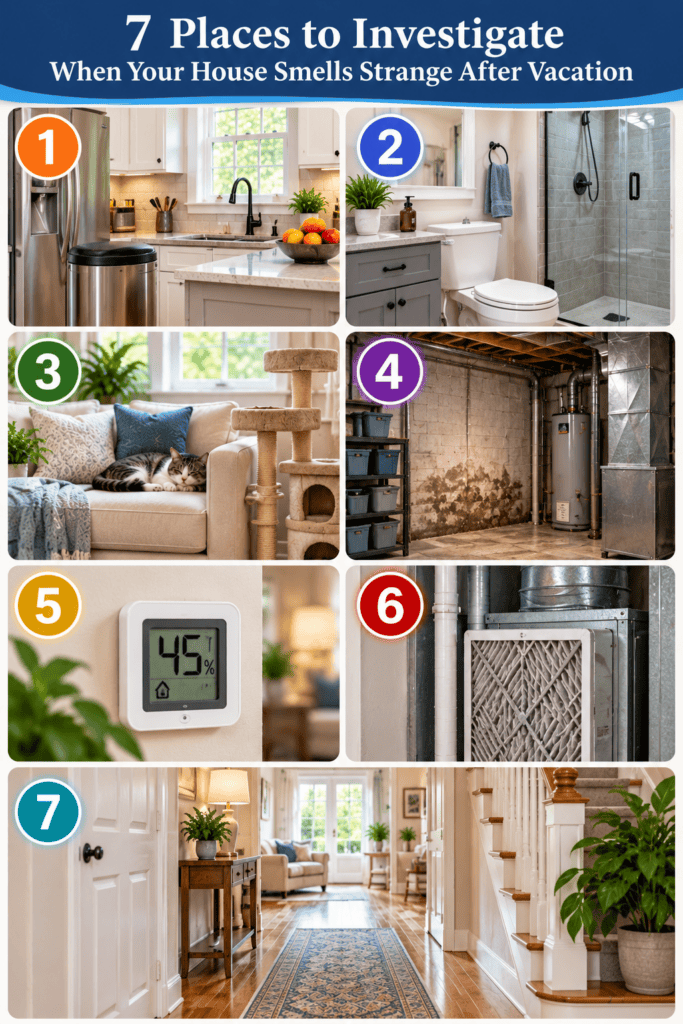
1. Check the Kitchen
Start with the obvious suspects.
Look at the trash can, garbage disposal, refrigerator, forgotten produce, recycling containers, pet food and anything left sitting in or around the sink.
A small food-related odor that normally blends into everyday household activity can become extremely obvious when you first walk into a closed house.
Cleaning the source is far more useful than trying to cover the odor with fragrance.
2. Check Your Bathrooms and Drains
Bathrooms deserve a quick inspection whenever a house has been unoccupied.
Check sinks, tubs, showers, toilets, floor drains and areas around plumbing fixtures.
If the odor seems strongest around a particular drain or bathroom, the location itself is an important clue.
Persistent sewage-like or unusual plumbing odors should be investigated rather than masked.
3. Check Pet Areas
Here's where nose blindness can become especially noticeable.
If you live with pets, you may gradually become accustomed to some of the odors associated with them.
After several days away, however, you may suddenly notice odor around:
- Dog beds
- Cat furniture
- Litter boxes
- Carpeting
- Upholstered furniture
- Area rugs
- Baseboards
- Previous accident locations
Pet urine can be particularly difficult because contamination can extend below the surface of carpet or other porous materials.
If an odor returns repeatedly after cleaning, there may be a source you haven't completely located.
4. Check the Basement and Crawl Space
If the odor is musty, earthy or damp, pay attention.
Basements, crawl spaces and other lower areas of the home can contain moisture conditions that affect odors elsewhere in the building.
The CDC notes that mold can have a musty odor and that mold growth is associated with moisture. It recommends addressing both mold and the underlying moisture problem when mold is present.
However, smell alone does not tell you exactly what is causing the problem.
A musty odor is a reason to investigate moisture—not a laboratory test for mold.
Look for signs such as:
- Water intrusion
- Damp materials
- Plumbing leaks
- Condensation
- Wet carpeting
- Discoloration
- Persistent high humidity
If you've noticed that your house also smells different during rainy weather, read our guide “Why Does My House Smell Musty When It Rains?” for a deeper look at the relationship between moisture and household odors.
5. Check Indoor Humidity
Humidity deserves special attention in Maryland homes.
The EPA generally recommends keeping indoor relative humidity between approximately 30% and 50%. Higher humidity increases the likelihood of conditions that can support mold growth.
A small digital hygrometer can help homeowners determine whether humidity is actually elevated instead of trying to judge moisture conditions by feel.
If the house was warmer than usual while you were away, the HVAC system was adjusted, or outdoor conditions were particularly humid, compare humidity levels throughout the house.
Basements may behave very differently from upstairs living areas.
6. Check the HVAC System
Your heating and cooling system moves air throughout much of your home.
That makes it worth paying attention to when an odor appears.
Ask yourself:
Does the smell become stronger when the HVAC system turns on?
If it does, investigate the system, filters and surrounding areas.
The EPA identifies HVAC operation and maintenance as one of the factors that can influence indoor air quality and recommends regular filter maintenance as part of good indoor-air practices.
An odor associated with HVAC operation doesn't automatically mean the HVAC system itself is contaminated, but the timing can provide an important clue about where to investigate.
7. Follow Your Nose Room by Room
This sounds almost too simple, but it can be one of the most useful things you do.
Don't immediately spray air freshener throughout the house.
Instead, investigate while your sense of smell is still relatively fresh.
Walk slowly through the home.
Where does the odor become stronger?
Check individual rooms.
Move toward walls.
Check around furniture.
Inspect carpeting.
Open closets.
Walk downstairs.
Check around plumbing.
Smell near—not inside—HVAC registers.
You're looking for a pattern.
The difference between “my whole house smells weird” and “the odor becomes much stronger along this wall beside the sofa” can dramatically narrow the search.
Also Read 📖Top Causes for Household Odors & How to Address Them
Don't Confuse Odor Removal With Odor Masking
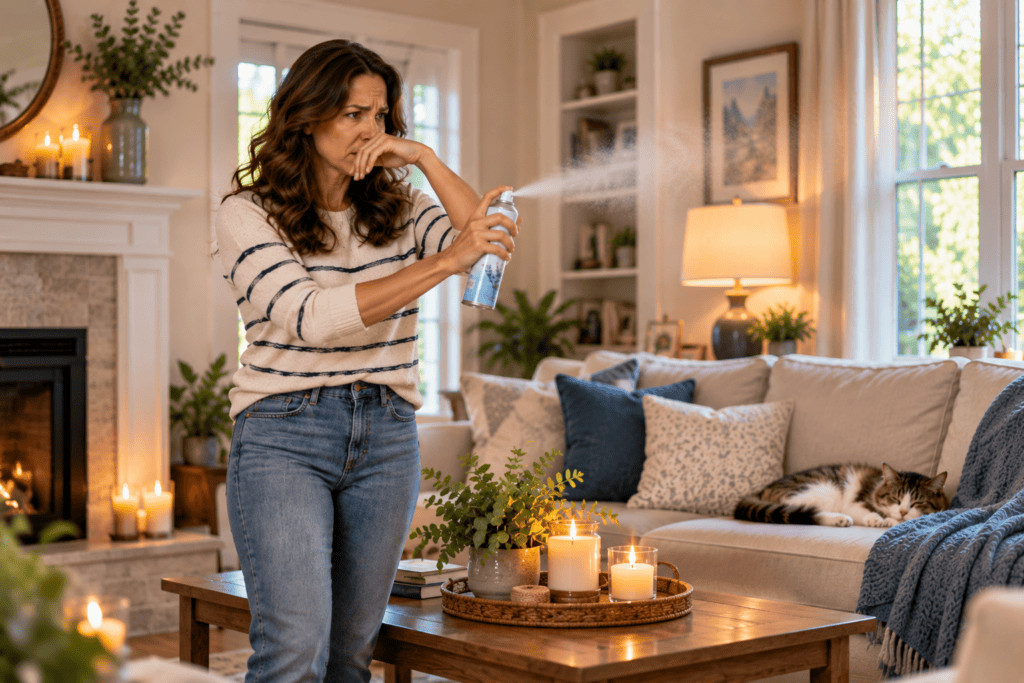
When something smells unpleasant, our first instinct is often to make the room smell better.
So we light a candle.
Spray an air freshener.
Plug in a fragrance device.
Use a heavily scented cleaner.
And sometimes the room temporarily smells better.
But the original odor source may still be there.
If the problem is contaminated carpet, pet urine, moisture, organic material or another persistent source, adding fragrance changes what you smell without necessarily changing why you're smelling it.
EPA indoor-air guidance emphasizes source control as a primary strategy for improving indoor air quality, along with ventilation and filtration.
That same principle makes sense for odor investigation:
Find the source before trying to cover the symptom.
Also Read 📖Scent vs. Odor: Why Candles and Air Fresheners Make Smells Worse
Your “Fresh Nose” Can Actually Be Useful
There's an interesting upside to coming home and thinking:
Whoa. What is that smell?
For perhaps the first time in weeks or months, you're experiencing your home's odor environment differently.
Don't waste that opportunity.
Before unpacking, cooking dinner, spraying fragrance or spending several hours inside, take five minutes and investigate.
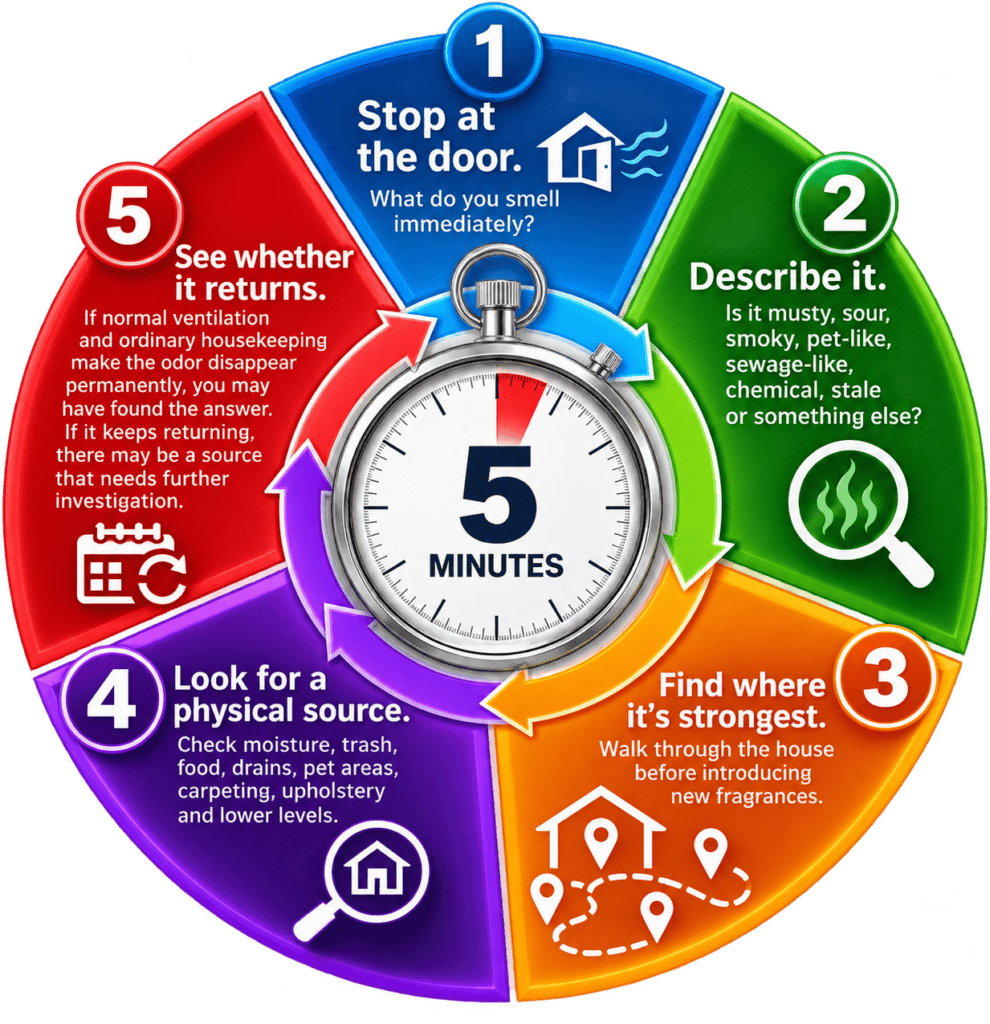
The Five-Minute Homecoming Odor Check
Step 1 — Stop at the door.
What do you smell immediately?
Step 2 — Describe it.
Is it musty, sour, smoky, pet-like, sewage-like, chemical, stale or something else?
Step 3 — Find where it's strongest.
Walk through the house before introducing new fragrances.
Step 4 — Look for a physical source.
Check moisture, trash, food, drains, pet areas, carpeting, upholstery and lower levels.
Step 5 — See whether it returns.
If normal ventilation and ordinary housekeeping make the odor disappear permanently, you may have found the answer. If it keeps returning, there may be a source that needs further investigation.
When a Persistent Odor Deserves Professional Investigation
Not every post-vacation smell requires professional odor removal.
Sometimes the trash simply needed to go out.
Sometimes the house needed ventilation.
And sometimes your freshly reset sense of smell noticed the normal background scent of your home.
But an odor deserves more attention when it is persistent, unexplained, concentrated in a particular location, associated with moisture, or repeatedly returns after cleaning.
That's especially true when you can't identify exactly where it's coming from.
Professional odor remediation should begin with investigation rather than simply adding another fragrance to the environment.
At Maryland Odor Pros, the objective is to help identify and address the odor source whenever possible.
Because if you can smell something every time you return home, covering it up isn't the same thing as solving it.
Coming Home Should Smell Like Home
That strange smell after vacation may reveal something fascinating about your own sense of smell.
You may have become accustomed to an odor that was there all along.
Or your home's indoor environment may actually have changed while you were away.
Either way, don't immediately assume you need a stronger air freshener.
Use your fresh nose as a diagnostic tool.
Follow the odor. Look for moisture. Check the places where smells commonly originate. Pay attention to whether it disappears—or keeps coming back.
And when an odor persists but the source remains a mystery, that's when a professional assessment can help turn “What is that smell?” into a much more useful question:
“Where is it coming from?”
Need Help Finding a Persistent Odor?
If you've returned home to an odor that won't go away—or you've realized your house has a smell you simply stopped noticing—Maryland Odor Pros can help investigate persistent household odor problems and determine appropriate next steps.
Contact Maryland Odor Pros to schedule an odor assessment.


Frequently Asked Questions
1. Why does my house smell different after I’ve been away?
One reason is olfactory adaptation, often called nose blindness. When you're continuously exposed to familiar household odors, you may become less aware of them. Spending several days away reduces that continuous exposure, so familiar smells may seem much stronger when you return. However, ventilation, humidity, drains, pets, food and other conditions can also change while the home is unoccupied.
2. What is nose blindness?
Nose blindness is the everyday term commonly used to describe reduced awareness of an odor after prolonged or repeated exposure. In scientific discussions, this is associated with olfactory adaptation. It helps explain why homeowners may stop noticing familiar background odors that visitors detect almost immediately.
3. How can I tell what my house smells like to other people?
Try leaving the house and spending some time in fresh air before returning. When you reenter, avoid immediately using candles, sprays or other fragrances. Pay attention to your first impression and walk through different rooms to determine whether an odor becomes stronger in a particular area.
4. Why does my house smell musty after vacation?
A musty smell can be associated with elevated humidity, damp materials, inadequate ventilation, water intrusion or microbial growth. Odor alone cannot determine the exact cause, so investigate basements, crawl spaces, bathrooms, plumbing, HVAC areas and other locations where moisture may accumulate.
5. Why do I notice my pets' smell more after I've been away?
You may have gradually adapted to familiar pet odors while living with them every day. After several days away, those odors can become much more noticeable. Check pet bedding, litter areas, rugs, carpeting, upholstered furniture and locations where previous accidents may have occurred.
6. Can an empty house actually develop odors while I'm gone?
Yes. A home's indoor environment continues changing even when nobody is there. Humidity and temperature can fluctuate, garbage or food can produce odors, drains may become noticeable, and changes in ventilation or HVAC operation can affect how odors accumulate and move throughout the home.
7. Should I use an air freshener if my house smells strange when I return?
It's usually better to investigate first. Fragrance products may change what you smell without eliminating the underlying source. Before introducing another scent, determine where the odor is strongest and inspect common sources such as trash, drains, pets, carpeting, upholstery and moisture-prone areas.
8. Why does the smell become stronger when my HVAC system turns on?
If an odor becomes more noticeable when the heating or cooling system operates, moving air may be transporting an odor from another location. Check the filter, registers and accessible HVAC areas, but don't automatically assume the HVAC system itself is the source. The timing of the odor is a clue that can help narrow the investigation.
9. When should I be concerned about a persistent smell in my house?
An odor deserves additional investigation when it repeatedly returns, becomes stronger over time, is concentrated in a specific location or appears alongside moisture, water damage or another identifiable problem. Sewage, burning, gas-like or strong chemical odors may require prompt attention from the appropriate qualified professional or utility rather than ordinary odor remediation.
10. When should I call a professional for a house odor?
Consider professional help when you've cleaned and ventilated the home but an unexplained odor continues to return, particularly when you cannot locate its source. A professional odor assessment can help narrow down where the odor originates and determine whether additional cleaning, remediation or another type of specialist is appropriate.
Previous Article: Why Does My House Smell Musty When It Rains?
Next Article: Pet Odors in Rental Properties: What Landlords Need to Address Before Re-Renting