


Why Do Some Odors Come and Go? The Science Behind Disappearing Household Smells
Estimated reading time: 7–8 minutes
Executive Brief
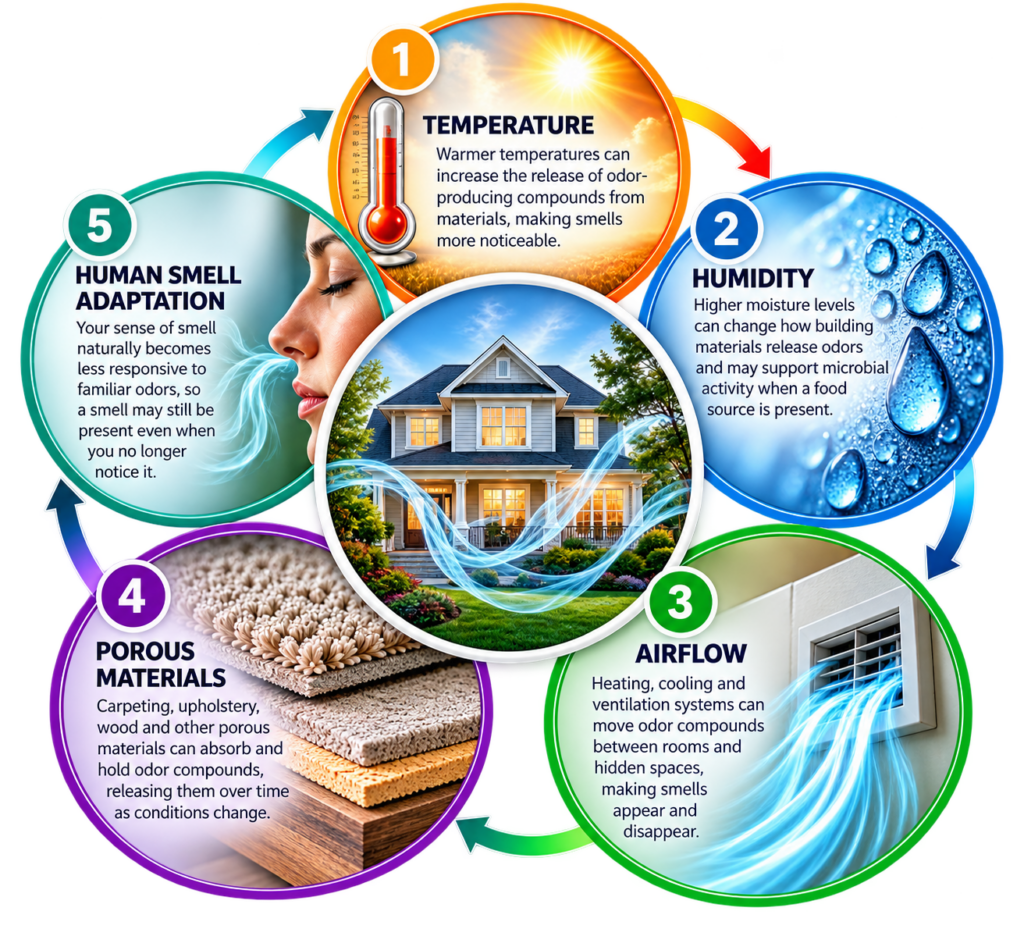
Intermittent household odors often result from changes in environmental conditions rather than the spontaneous disappearance of an odor source. Temperature affects the release of volatile compounds, humidity influences moisture-sensitive materials, and airflow transports odors between rooms and concealed spaces.
Human olfactory adaptation also plays a significant role. People may stop noticing a smell after prolonged exposure, even when odor-producing compounds remain present.
Identifying the underlying source is essential for determining whether ordinary housekeeping, ventilation improvements, maintenance, or professional odor assessment is appropriate.
Key Takeaways
-
A disappearing odor does not necessarily mean the source has been eliminated.
-
Temperature and humidity can change how strongly certain materials release odors.
-
HVAC operation and air-pressure differences can move odors throughout a house.
-
Carpeting, upholstery, wood, and other porous materials can retain and release odor-producing compounds.
-
Your sense of smell naturally adapts to prolonged exposure.
-
Recurring odors deserve investigation, especially when they consistently appear in the same location.
Have you ever walked into your home and noticed a strange smell, only to discover that it disappeared an hour later? Perhaps your living room occasionally smells musty, your hallway develops an unexplained sour odor, or a particular room smells unpleasant only when the weather changes.
You search for the source, open a few windows, and the smell disappears. Problem solved, right?
Not necessarily.
One of the most frustrating characteristics of household odors is that they do not always remain consistent. Some odors appear only during certain weather conditions, at particular times of day, or when heating and cooling systems operate.
Understanding why this happens requires looking beyond the smell itself and examining the environmental conditions that influence how odor molecules are released, transported, and perceived.
For Maryland homeowners, seasonal humidity, changing temperatures, tightly sealed homes, and variations in ventilation can make intermittent odors particularly noticeable.
The important question isn't simply why the smell disappeared.
It's whether the source disappeared with it.
Also Read 📖Why Does My House Smell Musty When It Rains?
The Science of Smell: Why Odors Are Not Always Constant
Every odor begins with chemical substances that reach the odor receptors inside your nose.
Many familiar household smells involve volatile organic compounds (VOCs), although not all odor-producing substances are classified as VOCs.
These compounds may originate from cooking, pets, cleaning products, building materials, biological activity, or substances absorbed into household surfaces.
For you to detect an odor, enough of the responsible chemical compounds must reach your nose at concentrations you can perceive.
Three conditions influence this process:
-
Emission: How quickly odor-producing compounds enter the surrounding air.
-
Transport: How air movement carries those compounds through the building.
-
Perception: Whether the concentration reaching your nose exceeds your individual detection threshold.
These conditions can change independently.
For example, an odor source beneath carpeting may remain unchanged while increased ventilation temporarily reduces the concentration of odor compounds in the room.
When the windows close and airflow decreases, the smell may become noticeable again.
This explains an important distinction:
Odor intensity is not always a reliable measurement of how much contamination or odor-producing material is present.
1. Temperature Changes Can Make Hidden Odors More Noticeable
Have you noticed that certain household smells become stronger on warm afternoons?
Temperature can affect the volatility of many odor-producing compounds.
As temperatures rise, some substances evaporate or release chemical compounds into the air more rapidly.
This process can make existing odors easier to detect.
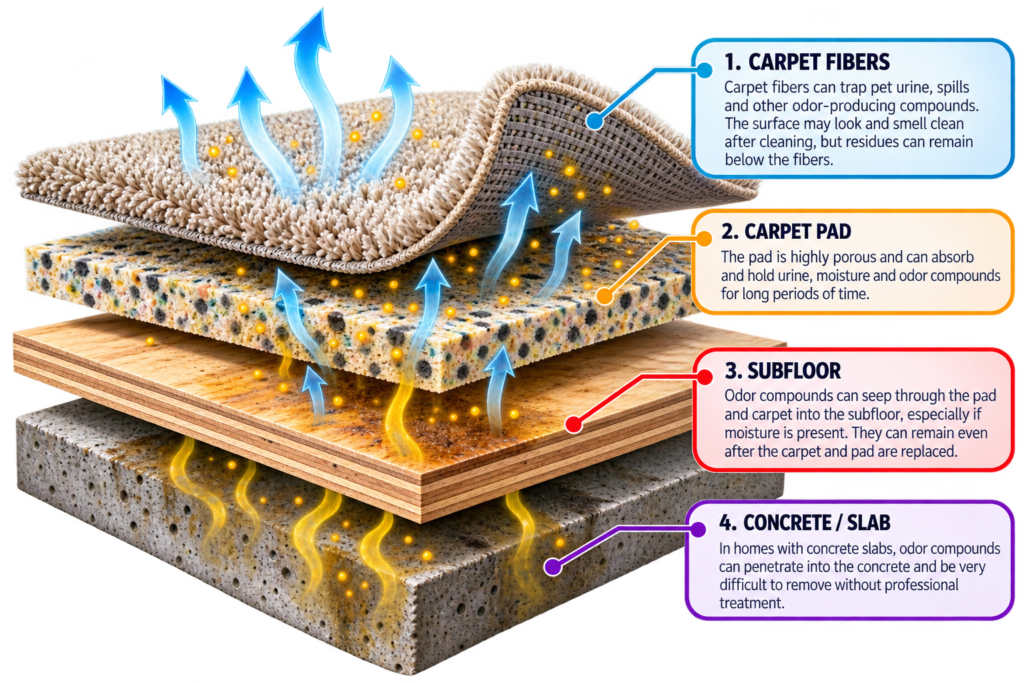
Consider a carpet that previously absorbed pet urine.
Even after the surface appears clean, odor-producing residues may remain within the carpet backing, padding, or underlying flooring.
As environmental conditions change, the concentration of odor compounds entering the surrounding air may increase.
The result?
A room that smelled perfectly normal in the morning may develop an unpleasant odor later in the day.
Temperature-related odor changes may occur around:
-
Sun-warmed carpeting and flooring.
-
Upholstered furniture near windows.
-
Attics and enclosed storage areas.
-
Garages and utility rooms.
-
Materials affected by historical spills or smoke exposure.
Temperature does not create every odor, but it can influence how strongly an existing source affects indoor air.
Also Read📖OdorPro Tips: Keep Your Maryland Home Smell-Free Year Round
2. Humidity: Why Some Odors Return When It Rains
Maryland experiences significant seasonal changes in humidity, particularly during warmer months.
When moisture levels increase, certain household odors may become more noticeable.
This happens for several reasons.
First, some building materials absorb moisture from the surrounding air. Increased moisture can alter the release of odor-producing compounds already present in those materials.
Second, damp conditions can support microbial activity when a suitable source of nutrients is available.
Third, changing weather conditions may alter ventilation patterns and air movement within a building.
This helps explain why some homeowners notice musty or earthy odors during rainy weather, even when no visible water is present.
Common locations worth inspecting include basements, crawl spaces, laundry rooms, and areas around plumbing.
However, a musty smell alone cannot establish whether microbial growth is present or identify a specific source.
If you consistently notice an odor after rainfall, document where it occurs and check for moisture intrusion or condensation.
For additional homeowner guidance, explore our related article, Why Does My House Smell Musty When It Rains?.
3. Your HVAC System May Be Moving Odors Between Rooms
Sometimes an odor seems to travel.
You notice it in the hallway one evening, near a bedroom the following morning, and nowhere at all during the afternoon.
Although this may seem mysterious, the explanation can involve ordinary air movement.
Heating, ventilation, and air-conditioning systems continuously influence how air circulates throughout a building.
When fans operate, they can create pressure differences that move air through doorways, ductwork, and small openings between building spaces.
Air carrying odor-producing compounds may enter occupied rooms from another location.
Potential pathways include:
-
Gaps around plumbing penetrations.
-
Openings between wall cavities and living spaces.
-
Poorly sealed duct connections.
-
Utility chases and basement access points.
-
Air movement between garages and adjoining rooms.
An odor that appears only when the heating or cooling system operates may indicate that airflow is transporting compounds from a source elsewhere in the building.
The HVAC system itself is not necessarily responsible for creating the smell.
It may simply be making an existing odor noticeable.
Also Read 📖What Role Does Our HVAC Play in Our Household Odors?
4. Porous Materials Can Store and Release Odors Over Time
Some household materials are particularly effective at retaining odor-producing substances.
Carpeting, upholstered furniture, unfinished wood, drywall, and certain insulation materials can absorb compounds or allow residues to penetrate beneath exposed surfaces.
This is one reason ordinary surface cleaning may not permanently resolve every odor problem.
Consider an older home with a history of cigarette smoke exposure.
Even after walls are repainted and carpeting is replaced, odor-producing residues may remain on or within other surfaces.
Changes in temperature, humidity, and ventilation can influence how those compounds are released into indoor air.
A similar problem may occur following pet accidents, cooking smoke, or spills that penetrate flooring.
The important distinction is between cleaning the visible surface and addressing the actual source.
If odor-producing material remains inside a porous surface, the smell may return when conditions become favorable for its release.
Also Read 📖New Pet at Home? How to Prevent Odors Before They Start
5. Why Your Nose Stops Detecting a Smell That Is Still There
One of the most fascinating explanations for disappearing odors has nothing to do with the house.
It involves your brain.
The human olfactory system naturally becomes less responsive to certain odors during continuous exposure.
This process is commonly called olfactory adaptation.
Imagine entering a room where someone recently prepared a strongly scented meal.
At first, the aroma is obvious.
After spending twenty minutes in the room, you may barely notice it.
Yet a visitor walking through the door might immediately detect the same smell.
The odor did not necessarily disappear.
Your sensory system adjusted to it.
This explains why homeowners sometimes report that their house smells normal while guests notice an unfamiliar odor.
It also explains why leaving the house for several hours can make a previously unnoticed smell apparent upon returning.
If this sounds familiar, our related guide, Why Does My House Smell Different After I've Been Away?, explores the phenomenon in greater detail.
Importantly, olfactory adaptation does not mean that an environment is safe. Some hazardous gases have no odor, while others may not provide a reliable warning at dangerous concentrations.
Also Read 📖Maryland’s 10 Worst Smells (And How Pros Remove Them)
Psychophysical and Behavioral Characterization of Olfactory Adaptations
Five Common Household Odors That May Come and Go
Not every intermittent smell has the same explanation.
The odor's character, location, timing, and environmental conditions can provide useful clues.
| Odor description | Possible explanation | What to investigate |
|---|---|---|
| Musty or earthy | Moisture, damp materials, or microbial activity | Basements, crawl spaces, condensation, water intrusion |
| Sour or ammonia-like | Pet residues, organic waste, or cleaning-product residues | Carpet padding, flooring, pet areas |
| Smoky or stale | Residual smoke compounds or air entering from another location | Walls, furnishings, HVAC pathways |
| Sewage-like | Drain-trap issues, plumbing leaks, or sewer gas | Floor drains, plumbing fixtures, venting |
| Chemical or solvent-like | Products, stored chemicals, coatings, or other sources | Garages, storage areas, recent renovations |
These are investigative possibilities, not definitive diagnoses.
Safety note: A rotten-egg or sulfur-like smell may indicate a natural gas leak. Leave the building and contact the gas utility or emergency services from a safe location. Do not operate electrical switches or attempt to locate the leak yourself. Likewise, a burning electrical smell, suspected carbon monoxide exposure, or sudden chemical fumes warrants appropriate immediate safety action rather than routine odor troubleshooting.
How to Identify an Odor That Keeps Disappearing

When a smell is intermittent, trying to identify it while it is absent can be difficult.
A more useful approach is to look for patterns.
The Maryland Homeowner's 5-Step Odor Investigation
-
Record when the odor appears. Note the time of day, weather, and whether heating or cooling equipment is operating.
-
Identify the strongest location. Determine whether the smell is concentrated in one room, near a surface, or around an air vent.
-
Look for environmental triggers. Does the odor return during rain, warm weather, high humidity, or after a room has been closed?
-
Investigate likely sources safely. Check accessible areas for spills, pet accidents, damp materials, waste, or maintenance problems.
-
Observe whether the smell returns. If ordinary cleaning or ventilation provides only temporary relief, the underlying source may remain.
A simple odor diary can make the investigation significantly more productive.
Rather than relying on memory, homeowners can compare repeated observations and identify conditions that consistently accompany the odor.
This information may also help an odor-removal professional narrow down potential sources during an assessment.
Why Air Fresheners Do Not Solve Recurring Odor Problems

When a strange smell appears, many homeowners reach for a scented spray, candle, or plug-in fragrance.
These products may temporarily change how a room smells, but fragrance alone does not necessarily remove the source of the original odor.
Some products mask unpleasant compounds with stronger scents.
Others may contain ingredients that interact with particular odor molecules.
However, whether a product provides genuine odor reduction depends on its chemistry, the substances involved, and how it is used.
If the odor originates from contaminated carpet padding, for example, adding fragrance to the surrounding air does not remove the residue beneath the carpet.
Once the added fragrance dissipates, the original odor may become noticeable again.
Persistent odor management should begin with source identification and appropriate correction, rather than repeatedly covering the smell.
Also Read 📖Scent vs. Odor: Why Candles and Air Fresheners Make Smells Worse
When Should You Consider a Professional Odor Assessment?
An occasional household smell may have a simple explanation.
Cooking, household activities, temporary ventilation changes, and ordinary maintenance issues can all produce short-lived odors.
However, recurring odors deserve additional attention when they:
-
Return repeatedly despite normal cleaning.
-
Appear in the same room or location.
-
Become stronger during particular weather conditions.
-
Persist after a known spill or pet accident.
-
Affect multiple rooms without an obvious source.
-
Remain noticeable to visitors even when occupants no longer detect them.
Professional odor assessment can help evaluate the circumstances surrounding a recurring smell and identify appropriate next steps.
Some problems require plumbing repairs, moisture correction, HVAC maintenance, or another specialized service before odor treatment can be effective.
A successful approach addresses the source whenever possible rather than treating odor symptoms alone.
Maryland Odor Pros: Helping Homeowners Get to the Source
At Maryland Odor Pros, we understand how frustrating it can be when an unpleasant smell disappears before you can determine where it came from, only to return days later.
Intermittent odors can affect your comfort, your confidence in your home, and the experience of anyone entering the property.
Our approach begins with understanding the odor concern, its history, and the conditions under which it becomes noticeable.
Whether the issue involves lingering pet odors, smoke-related smells, or other persistent household odor concerns, identifying the likely source is an important part of determining the appropriate solution.
We believe homeowners deserve more than another fragrance that temporarily covers an unpleasant smell.
They deserve answers.
If a mysterious smell keeps returning to your Maryland home, contact Maryland Odor Pros to discuss a professional odor assessment.
A Disappearing Smell May Still Have a Source
Household odors are influenced by a complex relationship between chemistry, building conditions, and human perception.
Temperature can change how compounds are released. Humidity can affect moisture-sensitive materials. Airflow can transport odors between rooms. And the human nose can become less responsive to smells that remain present.
These factors help explain why a home may smell unpleasant one day and perfectly normal the next.
The most important lesson is simple:
When an odor keeps returning, pay attention to what changes around it—not just whether you can smell it at that moment.
Understanding those patterns is often the first step toward finding the source and achieving a more lasting solution.
Still Can't Find Where That Smell Is Coming From?
If you've tracked the weather, checked your flooring, and inspected the usual trouble spots but the odor keeps returning, the source may be harder to identify than it seems.
Maryland Odor Pros helps homeowners investigate persistent household odor concerns and determine appropriate odor-removal solutions.
Book Your Free Consultation Today


Frequently Asked Questions: Why Do Some Household Odors Come and Go?
1. Why does a smell come and go in my house?
A smell may come and go in your house because temperature, humidity, airflow, and indoor air pressure influence how odor-producing compounds move through your home. Certain materials can also absorb and release odor compounds as environmental conditions change. If the source remains, the odor may return even after temporarily disappearing.
2. Why does my house smell bad sometimes but not all the time?
Intermittent household odors often occur when environmental conditions change. Warmer temperatures may increase the release of certain odor compounds, while humidity and ventilation can influence their concentration in indoor air. Heating and cooling systems may also transport odors between rooms, making a smell noticeable only at certain times.
3. Why do strange smells appear in my house when it rains?
Rainy weather can increase moisture levels in building materials and change airflow patterns around a home. Damp conditions may make existing musty odors more noticeable, particularly in basements, crawl spaces, and poorly ventilated areas. If an odor consistently appears after rainfall, investigate possible moisture intrusion, condensation, or other hidden sources.
4. Can an odor disappear even when the source is still present?
Yes. An odor can become undetectable without its source being eliminated. Increased ventilation may temporarily dilute odor compounds, while changes in temperature can reduce their release. Additionally, the human nose naturally adapts to prolonged exposure. When environmental conditions change or someone enters the home with a fresh sense of smell, the odor may become noticeable again.
5. Why does my house smell worse at night?
Some household odors become more noticeable at night because heating and cooling patterns, ventilation, temperature, and indoor activities change. Closed windows and reduced air exchange may allow certain odor compounds to accumulate. However, a nighttime odor does not automatically indicate a particular source. Tracking when and where the smell appears can help identify the cause.
6. Can carpet and furniture cause odors that come and go?
Yes. Carpeting, upholstered furniture, wood, and other porous materials can retain odor-producing compounds from pet accidents, smoke, food spills, and other sources. Changes in temperature, humidity, and airflow may affect how those compounds are released into indoor air. Surface cleaning may not fully resolve an odor when residues remain beneath the visible material.
7. Why can visitors smell something in my house that I cannot?
This commonly occurs because of olfactory adaptation, a natural process in which your sense of smell becomes less responsive to odors after prolonged exposure. Someone entering your home may immediately notice a smell that you no longer detect. This does not necessarily mean the odor has disappeared or that the source has been removed.
8. Can my HVAC system cause odors to move from room to room?
Yes. Heating and cooling systems influence air circulation and pressure differences throughout a home. Air carrying odor-producing compounds may travel through ductwork, openings around building materials, or connected spaces. If an odor appears primarily when your HVAC system operates, consider having the system and potential odor sources evaluated.
9. How can I find the source of a mysterious smell that keeps disappearing?
Start by recording when the odor appears, where it is strongest, and what environmental conditions are present. Note recent rainfall, temperature changes, HVAC operation, and household activities. Inspect accessible areas for spills, pet accidents, damp materials, plumbing problems, and other potential sources. If the odor repeatedly returns without an identifiable explanation, a professional assessment may help determine the next steps. Treat gas-like, burning, or strong chemical odors as potential safety hazards requiring immediate appropriate action.
10. When should I contact a professional for recurring household odors?
Consider professional odor assessment when an unpleasant smell repeatedly returns despite ordinary cleaning, ventilation, and basic maintenance. Persistent pet odors, lingering smoke smells, and unexplained odors in carpeting or other building materials may require further investigation. Maryland Odor Pros can help homeowners evaluate recurring odor concerns and explore appropriate odor-removal solutions. Contact Maryland Odor Pros to discuss your situation.
Read previous article: Why Does My House Smell After Vacation? | Maryland Odor Pros
Next Article:Where Is That Smell Coming From? How to Track Down an Odor in Your Home