


Buyers Decide in Seconds—Before They Even See the Kitchen
A buyer walks into a home…
…and within 3 seconds, they’ve already made a judgment.
Not about the layout.
Not about the finishes.
About the smell.
If something feels “off,” the brain jumps straight to:
- “There’s damage here”
- “This could be expensive”
- “Let’s keep looking”
That’s how deals quietly fall apart—before they even begin.
Why Odor Removal Matters More in Today’s Market
Today’s buyers are more cautious and more aware than ever.
They’re not just buying a home—they’re evaluating:
- Indoor air quality
- Health risks
- Long-term maintenance costs
Even mild odors can trigger:
- Concern about mold or moisture
- Suspicion of hidden damage
- Emotional discomfort that kills interest
And here’s the truth most sellers don’t hear:
👉 Buyers rarely say “it smells”
👉 They just don’t make an offer
Also Read 📖Hidden Science of Odor Removal in Maryland | Maryland OdorPros
The Most Common Odors That Kill Real Estate Deals
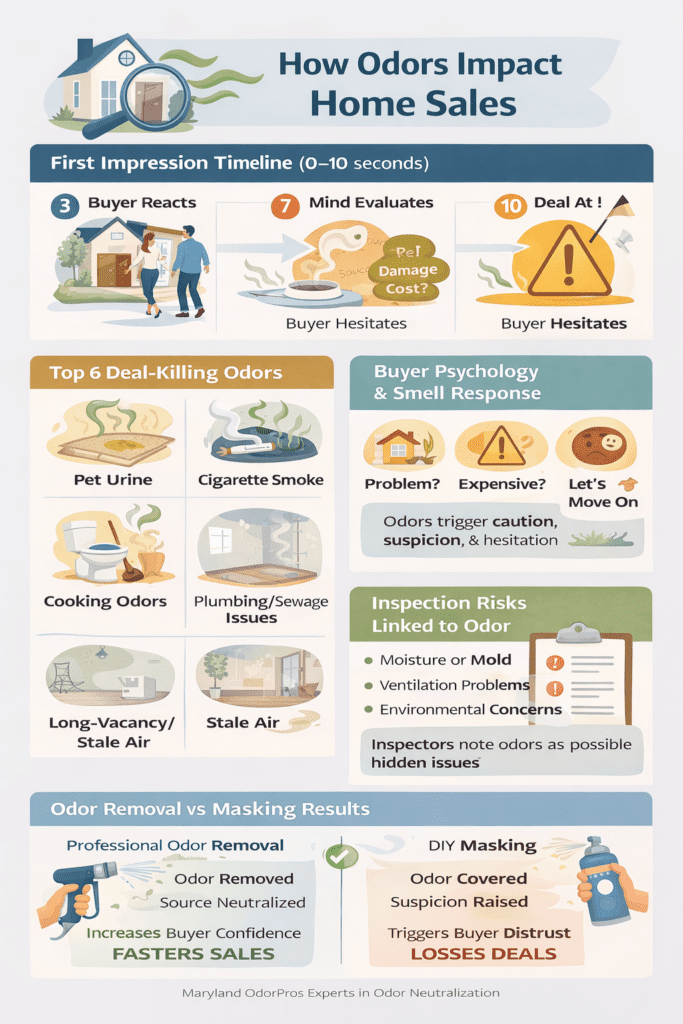
Not all odors are equal. Some are immediate red flags.
High-Risk Odors for Home Sales
- Pet urine embedded in carpet or subfloor
- Cigarette or cigar smoke
- Musty basement or crawlspace odors
- Mold-related smells
- Cooking grease or long-term food odors
- Sewage or plumbing issues
- Long-vacancy or stale air odors
These don’t just affect comfort—they signal risk and cost to buyers.
Real-World Scenario: The Listing That Wouldn’t Move
A Maryland realtor lists a clean, well-maintained home.
Photos look great. Price is competitive. Location is solid.
But during showings…
There’s a faint musty odor in the lower level.
What happens next:
- Buyers hesitate but don’t say why
- Showings happen, but offers don’t come
- One buyer submits an offer—then withdraws after inspection
The inspector notes:
👉 “Odor consistent with potential moisture issue”
Now the seller faces:
- Price reductions
- Negotiation pressure
- Time on market increasing
After professional odor removal:
- The source is treated
- Air quality improves
- The home relists and sells quickly
Nothing changed—except the smell.
The Biggest Mistake Sellers Make: Masking Instead of Eliminating
Let’s be blunt for a second…
Candles don’t sell houses.
Plug-ins don’t fix problems.
They raise suspicion.
Buyers walk in and think:
👉 “What are they trying to cover up?”
Why DIY Fails
Odors don’t live on the surface. They penetrate:
- Carpet and padding
- Drywall and paint
- Wood and subflooring
- HVAC systems
If you don’t remove the source, the odor returns—and buyers notice.
Also Read 📖Why are Fragrant Deodorizers the Wrong Way to Go?
What Professional Odor Removal Actually Does
Maryland OdorPros approaches odor differently.
Not as a surface issue—but as a source-based environmental problem.
Professional Process
- Identify the exact odor source
- Treat affected materials at a deep level
- Neutralize odor molecules (not mask them)
- Restore clean, neutral indoor air conditions
Result
- Odors are eliminated—not hidden
- Buyers walk in with confidence
- The home presents as clean and well-maintained
Why This Is a High-ROI Move for Realtors & Sellers

This is where strategy meets results.
Without Odor Removal
- Longer days on market
- Lower offers
- Inspection red flags
- Buyer hesitation
- Increased deal fallout
With Odor Removal
- Stronger first impressions
- Higher perceived value
- Faster buyer decisions
- Cleaner inspections
- Smoother closings
This is one of the highest-impact pre-listing improvements you can make.
The Hidden Leverage Buyers Use
Here’s what most sellers don’t realize:
Odor = negotiation leverage.
Inspectors often document odors as:
- Indicators of moisture
- Possible mold conditions
- Ventilation or environmental concerns
That gives buyers:
- Justification for price reductions
- Requests for remediation
- Reasons to walk away
Why This Matters Now
Realtors and sellers searching this aren’t curious…
They’re trying to solve a problem before it costs them a deal.
This is decision-stage thinking:
👉 “Do we fix this now, or risk losing the sale?”
The answer is simple:
Fix it before the market sees it.
Where the Market Is Headed

Over the next few years, expect:
- Increased buyer sensitivity to indoor environments
- More detailed inspection reporting
- Greater demand for move-in-ready homes
- Higher expectations for air quality and cleanliness
Odor-free won’t be optional.
It will be expected.
How Maryland OdorPros Supports Realtors & Sellers
Maryland OdorPros works as a pre-listing partner, not just a service provider.
Typical Workflow
- Assessment of odor presence
- Identification of underlying cause
- Targeted treatment plan
- Full odor elimination process
- Post-treatment confidence for showings
This allows agents to:
- List with confidence
- Avoid surprises
- Protect transaction momentum
Conclusion
If a buyer smells a problem, they assume a problem.
And assumptions cost you money.
Before listing your next property, ask:
👉 “Would this smell cost us the sale?”
If there’s any doubt, address it now—before buyers do.
Schedule a professional odor assessment with Maryland OdorPros and protect your listing from avoidable risk.
(FAQs)
1. Can odors really affect a home’s sale price?
Yes. Odors reduce perceived value and often lead to lower offers or buyer concessions.
2. What smells are the biggest deal-breakers for buyers?
Pet urine, smoke, mold/musty odors, and sewage-related smells are among the most problematic.
3. Will air fresheners fix the issue for showings?
No. They only mask odors and can make buyers more suspicious.
4. Do home inspectors report odors?
Yes. Odors are often noted as indicators of potential underlying issues.
5. How long does professional odor removal take?
Most treatments can be completed in hours to a day, depending on severity.
6. Can odors come back after treatment?
Not when properly treated at the source with professional methods.
7. Should odor removal be done before listing or after an offer?
Before listing. First impressions are critical for attracting strong offers.
8. Are buyers more sensitive to smells now than before?
Yes. Increased awareness of air quality and health has made buyers more sensitive.
9. Does odor removal increase time on market?
No—it typically reduces time on market by improving buyer response.
10. Is odor removal worth the investment for sellers?
Absolutely. It’s one of the highest ROI improvements for a successful sale.
Previous Article: New Pet at Home? How to Prevent Odors Before They Start
Next Article: Why Your New Home Still Smells After Cleaning (And What It Means)