


Why Doesn’t Cleaning Remove Smoke Odor After Tenants?
Smoke odor after tenants persists because odor-causing compounds penetrate porous materials (drywall, insulation, carpets), bind to surfaces, and recirculate through HVAC. Surface cleaning removes residues you can see, but it rarely neutralizes the embedded molecules that keep re-off-gassing—especially in warm, humid conditions common in Maryland.
The uncomfortable truth property managers learn the hard way
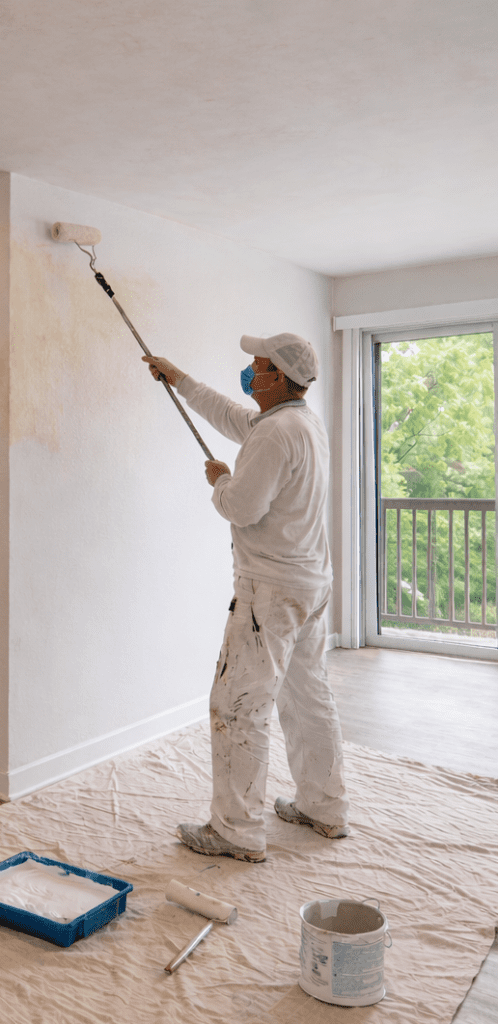
If you manage apartments or rentals, you’ve probably lived this scene:
You repaint. You deep-clean. You replace a few filters. The unit looks great. The walkthrough goes fine. Then the next tenant moves in… and calls you within 48 hours:
“Something smells like smoke.”
This isn’t a cleaning failure. It’s a physics-and-chemistry problem.
Smoke odor is notorious because it doesn’t behave like a typical “dirty house” smell. It behaves like a molecular stowaway—bonding to building materials, hiding in air pathways, and reappearing when temperature and humidity shift.
In Maryland, that reappearance can be dramatic. Humid summer air and warm HVAC cycles accelerate “re-off-gassing,” where trapped compounds release back into indoor air.
What “smoke smell” really is (and why it won’t stay gone)
Smoke odor isn’t one smell. It’s a complex mixture of volatile organic compounds (VOCs) plus sticky residues like tar and nicotine that cling to surfaces.
Two big reasons it persists:
1) Smoke penetrates porous materials
Apartments and rentals are full of porous and semi-porous materials:
- Painted drywall
- Acoustic “popcorn” ceilings
- Carpet and padding
- Baseboards and subfloors
- Cabinet interiors
- Blinds and window treatments
- Door frames and weatherstripping
Smoke compounds adsorb onto surfaces (they stick to them) and can also absorb deeper into materials (they soak in). Once embedded, those molecules can re-release into the air for weeks—or longer—especially with moisture and heat.
2) “Thirdhand smoke” is a real turnover problem
Even after visible residue is gone, “thirdhand smoke” refers to smoke compounds that remain on surfaces and in dust. In rentals, this matters because it keeps producing odor and can trigger complaints from sensitive occupants.
This is why “it smelled fine during the showing” isn’t proof the issue is solved. A vacant unit has different airflow, less humidity, and fewer daily heat cycles. Once occupied, odor can ramp up.
Why standard turnover cleaning fails (even when it’s thorough)
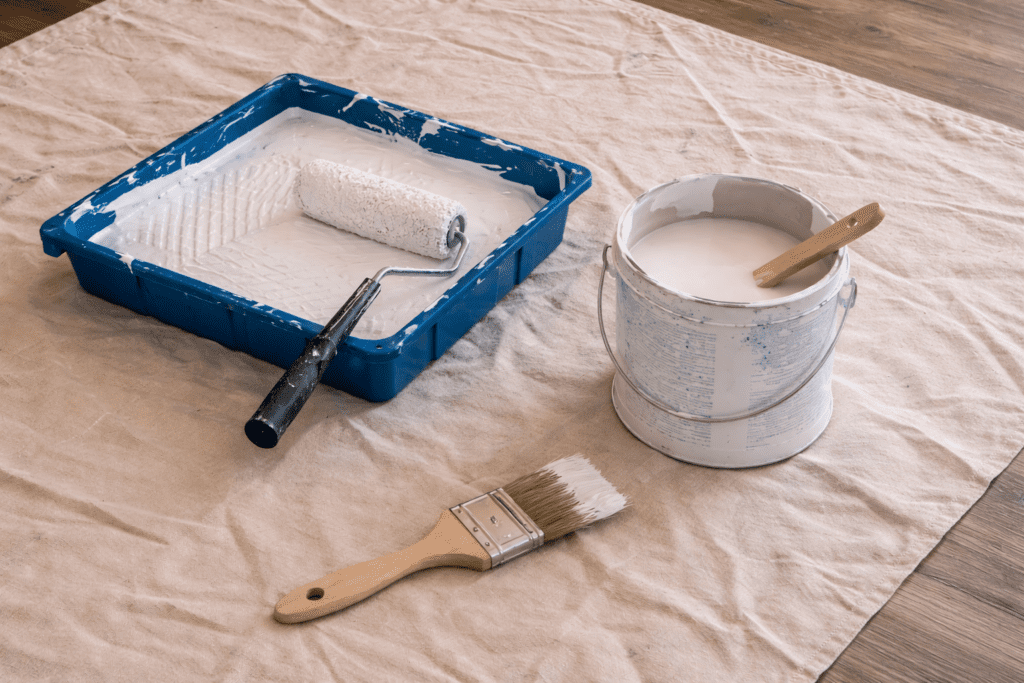
Typical turnover cleaning focuses on what’s visible:
- Mop, wipe, scrub
- Paint or primer
- Replace filters
- Shampoo carpets
- Run deodorizer sprays
Those steps can help, but they commonly miss the real reservoirs. Here are the usual culprits:
Painted walls aren’t sealed walls
Paint can hide staining, but it doesn’t reliably lock in odor molecules unless the correct sealing approach is used. Smoke compounds can migrate through standard paints, and the odor returns when the unit warms up.
HVAC systems don’t “hold” odor—they distribute it
If smoke residue exists in returns, coils, blower compartments, or duct interiors, the system becomes a distribution network. You can make the unit smell “better” temporarily, but once HVAC runs regularly, odor can re-circulate.
Ceilings are often the worst offender
Smoke rises. Textured ceilings have massive surface area. If ceilings weren’t addressed properly, you may be fighting a losing battle even after repainting walls.
Carpets can be replaced and you still lose
If smoke penetrated into tack strips, subfloor seams, or base plates, the unit can smell smoky even with brand-new carpet. This is why odor problems can persist in “fully renovated” rentals.
The smarter approach: smoke odor elimination that actually holds up
For property managers, the goal isn’t “make it tolerable today.” It’s make it non-detectable after occupancy—when humidity, cooking, showers, and HVAC cycles start.
Below is a reliable framework used in professional odor remediation.
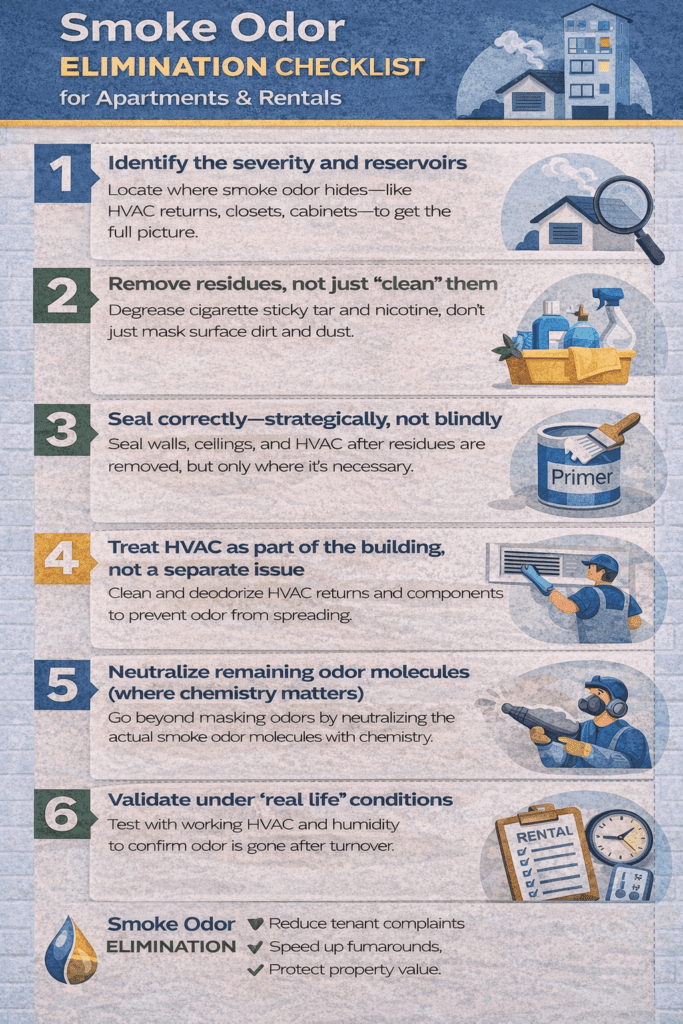
Step 1: Identify the severity and reservoirs
Not all smoke units are equal. A quick checklist:
- Do you smell it most near closets, returns, or bedrooms?
- Is it stronger with HVAC on?
- Does it intensify after showers or rainy weather?
- Are ceilings textured?
- Were windows left closed for long periods?
These clues tell you whether the main reservoir is surfaces, HVAC, soft goods, or structural materials.
Step 2: Remove residues, not just “clean” them
Smoke remediation begins with targeted residue removal:
- Degreasing of hard surfaces with appropriate smoke-residue cleaners
- Cleaning inside cabinets, drawers, and closet interiors
- Removing dust from trims, door tops, window channels, and blinds
(This is where smoke residue loves to hide because it’s sticky and airborne.)
Step 3: Seal correctly—strategically, not blindly
Sealing is a tool, not a magic spell. The mistake is sealing only the walls and ignoring ceilings, closets, and air pathways. A proper plan may include:
- Sealing odor-prone surfaces after residue removal
- Addressing ceilings (often the highest ROI move in heavy-smoke units)
- Not trapping contamination in HVAC pathways
Step 4: Treat HVAC as part of the building, not a separate issue
For apartments and rentals, smoke odor commonly returns through:
- Return vents pulling odor from wall cavities
- Residue on coils and blower components
- Duct interior dust holding smoke compounds
Professional HVAC-aware odor control typically includes:
- Filter upgrades during remediation (not as the only solution)
- Cleaning key internal components when indicated
- Confirming pressure and airflow issues aren’t pulling odor from hidden spaces
Step 5: Neutralize remaining odor molecules (where chemistry matters)
Once residues are removed and key surfaces are addressed, the remaining problem is often embedded molecules that continue to off-gas.
This is where professional oxidation-based odor neutralization can be useful. The goal is not masking; it’s chemically altering odor molecules so they no longer produce odor.
A professional will choose the appropriate method based on:
- Occupancy timeline
- Material sensitivity
- Severity (light vs heavy smoke)
- Presence of HVAC contamination
- Whether the unit is multi-family (odor transfer risk)
Step 6: Validate under “real life” conditions
A smart final check mimics occupancy:
- Run HVAC cycles
- Raise humidity temporarily (within safe limits)
- Close doors and let the unit sit
- Re-check closets, returns, and bedrooms
This step prevents the classic scenario: “passed the walkthrough, failed the move-in.”
Maryland-specific realities: why smoke odor complaints spike here
Maryland’s seasonal humidity matters. Higher humidity increases the perception and release of odor compounds from porous materials. That means a unit that seems “fine” during a dry spell can become a problem during humid weeks—especially in:
- Ground-floor units
- Older buildings with basements or crawl spaces
- Units with limited ventilation
- Properties near water or with chronic moisture issues
For property managers, that translates into a simple operational truth:
Smoke odor remediation must be designed to withstand humidity.
Practical guidance for landlords and property managers
Reduce complaints and turnover delays with these best practices
- Document the condition: If smoking is suspected, record observations early (walls, ceilings, vents, windows).
- Don’t rely on paint alone: Paint can hide, not neutralize.
- Treat ceilings as a priority: Especially textured ceilings.
- Address HVAC early: If odor intensifies when the system runs, don’t waste days on cosmetics.
- Avoid “fragrance fixes”: They backfire with sensitive tenants and can create new complaints.
- Use a repeatable process: The goal is consistency across turnovers, not heroic one-off cleanings.
Common mistake: starting with the “big visible” and skipping the “small invisible”
Most recurring smoke odor issues originate from small areas:
- Closet interiors
- Cabinet backs
- Door frames
- Return vents
- Bathroom exhaust paths
- Window channels and screens
- Blinds, shades, and fabric valances
Professionals check these first because they’re cheap to address and disproportionately responsible for “mystery returns.”
Conclusion: cleaning makes it look better—remediation makes it stay better
Smoke odor after tenants is one of the most expensive “invisible” problems in rental property management because it creates:
- Delayed move-ins
- Refund requests
- Lease cancellations
- Reputation hits from reviews
- Increased unit downtime
The core takeaway is simple: smoke odor persists because molecules persist—bonded to materials and distributed by airflow. To solve it reliably, you need a process that removes residues, addresses reservoirs (especially ceilings and HVAC), and neutralizes what’s embedded.
Maryland OdorPros specializes in odor elimination strategies designed to hold up under real occupancy conditions—so you can turn units faster, reduce complaints, and protect property value without relying on temporary cover-ups.
(FAQS)
-
Why does smoke smell come back after painting?
Because smoke compounds can remain in ceilings, HVAC systems, closets, or wall cavities. Paint may hide staining but won’t neutralize embedded odor molecules without proper residue removal and sealing strategy. -
How long does cigarette odor last in an apartment?
It can persist for weeks to months if residues and embedded compounds remain in porous materials like drywall, carpet padding, and HVAC dust. -
Can HVAC spread smoke odor to other rooms?
Yes. HVAC systems can redistribute odor through returns, ducts, and internal components if smoke residues or contaminated dust are present. -
What’s the difference between smoke residue and smoke odor?
Residue is the sticky film (tar/nicotine) on surfaces; odor is caused by volatile compounds that can bind to materials and off-gas over time. -
Why are closets often the smokiest-smelling areas?
Closets have less airflow, more fabric contact, and porous surfaces that trap odor molecules and re-release them when doors are closed. -
Does replacing carpet remove cigarette smell completely?
Not always. Odor can remain in subfloors, base plates, tack strips, and wall surfaces even after carpet replacement. -
Do air fresheners remove smoke odor?
No. They mask odors by adding fragrance. They do not neutralize the odor-causing molecules and often lead to stronger mixed odors. -
Can smoke odor cause tenant complaints even if the unit looks clean?
Yes. Smoke odor is often undetectable during short showings but becomes noticeable after occupancy when HVAC cycles and humidity increase. -
What areas should be prioritized for smoke odor remediation?
Ceilings, HVAC pathways, closets, cabinets, and porous surfaces are common reservoirs that must be addressed beyond standard surface cleaning. -
How can landlords prevent smoke odor issues in future turnovers?
Use consistent inspection documentation, address ceilings and HVAC early when smoking is suspected, and avoid fragrance-based “quick fixes” that don’t remove embedded compounds.