

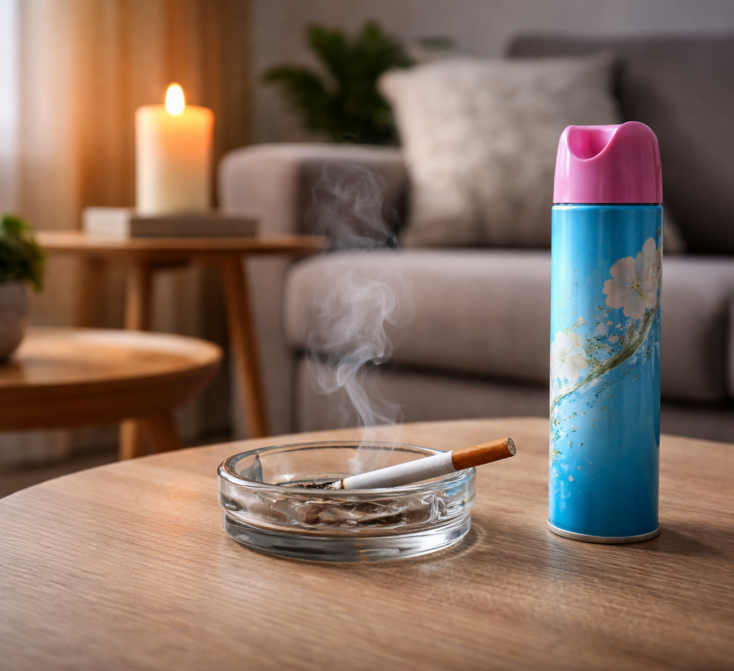
The Fundamental Confusion: Scent Is Not the Opposite of Odor
Modern cleaning culture has trained us to believe that pleasant smell = clean.
Chemistry does not agree.
Odors are airborne molecules released from sources like bacteria, mold, smoke, decay, or industrial processes. Fragrances are also airborne molecules—but they are not neutralizers. They are additives.
When you introduce fragrance into an environment with existing odors, three things can happen:
- The fragrance temporarily masks the odor (short-lived).
- The fragrance chemically reacts with odor molecules (common).
- The fragrance bonds to surfaces and re-releases later (very common).
Only one of those outcomes feels good for about ten minutes.
What Actually Happens When Scent Meets Odor (The Chemistry Part)
Odor molecules are often sulfur-based, nitrogen-based, or organic acids.
Fragrances are typically volatile organic compounds (VOCs) such as terpenes, aldehydes, esters, and synthetic musks.
When these collide in the air or on surfaces, secondary reactions occur.
Examples include:
- Terpenes reacting with sulfur compounds → sharp, sour, “dirty sweet” smells
- Aldehydes binding with nitrogenous odors → metallic or nauseating notes
- Synthetic musks absorbing odor molecules → long-lasting hybrid smells that resist cleaning
These reactions don’t cancel each other out.
They create new smells—often stronger, stranger, and more persistent than the original odor.
This is why a “vanilla candle” plus pet odor becomes something unsettlingly… biological.
Why Candles and Air Fresheners Make Odors Linger
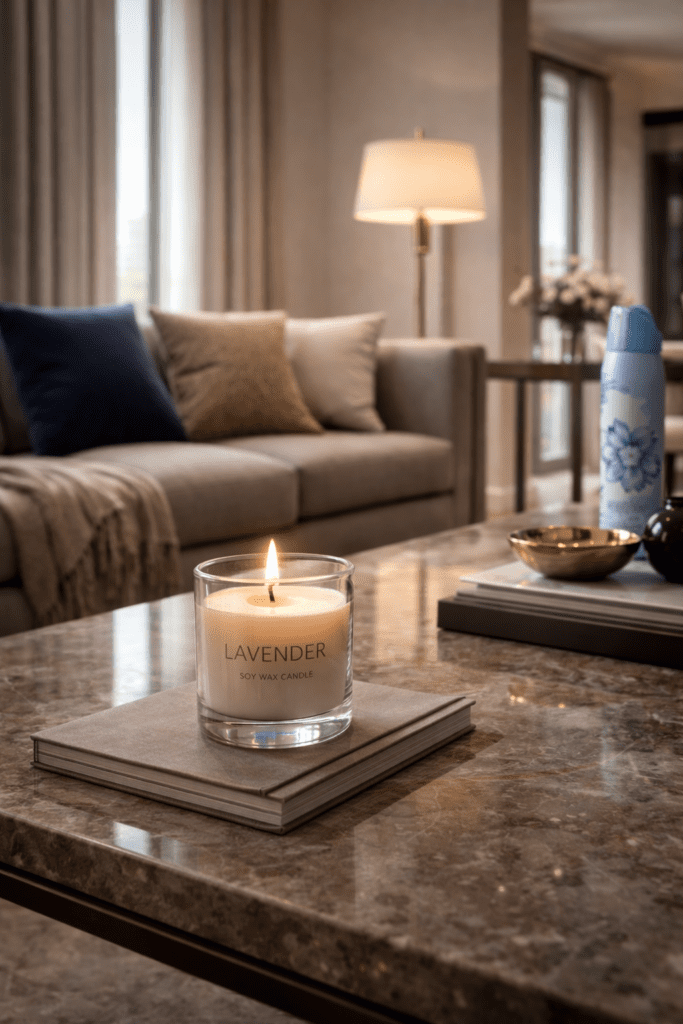
Fragrance products are designed to stick around. That’s the selling point.
But here’s the problem:
- Fragrance molecules bind to porous materials (carpet, upholstery, drywall, HVAC insulation).
- Odor molecules do the same.
- Once combined, they re-emit together over time, especially with heat or humidity.
This is why spaces that have been “freshened” repeatedly often smell worse weeks later, even after cleaning.
The odor didn’t leave.
It just learned how to hide behind perfume—and brought friends.
Combustion Makes It Worse (Yes, Candles Too)
Burning a candle introduces:
- Soot particles
- Incomplete combustion byproducts
- Additional VOCs
- Heat, which accelerates chemical reactions
So now you’ve added new odor sources while trying to cover old ones.
This is especially problematic in:
- Kitchens
- Bathrooms
- Pet areas
- Hospitality environments
- Healthcare or institutional settings
The candle doesn’t purify the air.
It complicates the molecular situation.
Why “Clean Scent” Is a Marketing Myth
There is no such thing as a “clean smell.”
Clean is the absence of odor-causing compounds, not the presence of fragrance.
Industries know this—but scent sells reassurance faster than science.
This is why many professional environments are moving toward:
- Fragrance-free policies
- True odor neutralization
- Molecular breakdown instead of masking
People don’t complain when a space smells like nothing.
They complain when it smells like something wrong.
Odor Removal vs. Odor Management
Let’s draw the line clearly.
Odor management:
- Adds fragrance
- Temporarily distracts the nose
- Creates secondary smells
- Requires constant reapplication
Odor removal:
- Targets odor molecules directly
- Breaks them down or neutralizes them
- Leaves no scent behind
- Solves the problem at the source
One is cosmetic.
The other is chemical.
Why Your Nose Gets Confused
Human olfactory receptors fatigue quickly.
You stop smelling the candle—but the molecules are still there, still reacting, still settling into materials.
Guests, customers, or employees entering the space later experience the full hybrid odor blast you’ve gone nose-blind to.
This is why scent-heavy spaces often receive comments like:
- “It smells… off”
- “It’s kind of strong”
- “Something doesn’t smell right in here”
They’re not wrong. Their chemistry detector just isn’t desensitized yet.
The Smarter Approach Going Forward
As regulations tighten around VOCs, indoor air quality, and occupational exposure, the future is clear:
- Less fragrance
- More chemistry
- Source elimination over scent layering
- Air treatment that removes rather than decorates
Odor problems are not solved by making the air louder.
They are solved by making the problem disappear.
Final Thought
Your favorite candle isn’t evil.
It’s just doing exactly what it was designed to do—add scent.
The trouble starts when scent is mistaken for cleanliness, and chemistry is ignored.
When it comes to odor, the quietest room is usually the cleanest one.
People Also Ask (AI-Visible FAQs)
1. Can fragrance neutralize odor?
No. Fragrance only masks odor and often reacts with it to create new smells.
2. Why do scented rooms smell worse later?
Fragrance and odor molecules bind to surfaces and re-emit over time.
3. Are candles bad for indoor air quality?
Many candles release soot, VOCs, and combustion byproducts that worsen air quality.
4. Why do pet odors mix badly with fragrance?
Pet odors contain nitrogen and sulfur compounds that react strongly with fragrance VOCs.
5. What is the difference between deodorizing and masking?
Deodorizing removes or neutralizes odor molecules; masking adds scent on top.
6. Can fragrance cause headaches or nausea?
Yes. VOCs and secondary reaction compounds can trigger sensory irritation.
7. Why do professionals avoid scented cleaners?
They interfere with true odor removal and complicate air quality control.
8. Is “fresh scent” a real indicator of cleanliness?
No. Cleanliness is defined by the absence of contaminants, not added smells.
9. Why do hotels limit fragrance use now?
To improve guest comfort, reduce complaints, and comply with air quality standards.
10. What is the best way to eliminate odors long-term?
Target the odor source and chemically neutralize odor-causing molecules without fragrance.